Patient materials.
Three pieces. A one-page handout to give someone on the spot, a tri-fold brochure to leave out for people to pick up, and a conversation card for nurses and NPs, the people most likely to raise the topic with a patient first. The patient pieces are concepts for sign-off, with placeholder photography.
Patient draft · photos are placeholders · pending clinical reviewOne page, handed over in person.
Plain, printable on a single sheet, and written to survive being read in a waiting room or on a kitchen table that evening. It answers the four things people ask before they ask anything else, and it always ends with the clinic's number.

You're not alone, and it's treatable.
Hemorrhoids are very common. Most people just want to feel like themselves again without a big operation or a long recovery. There is an outpatient procedure that may be able to help, and this page covers the basics.
- A consult. A short appointment where the surgeon examines you, answers everything, and tells you honestly whether this suits your situation.
- The procedure, if it is right for you. A separate outpatient visit, about 15 minutes.
- A follow-up, so we know how you are doing.
A consult carries no obligation. Plenty of people come in, ask their questions, and decide it isn't for them. That's a perfectly good outcome.
Seattle, WA
We accept commercial insurance and offer self-pay. We are not able to bill Medicare or Medicaid. This page is general information, not medical advice, and it is not a substitute for an examination. Published five-year results: Sias F, Milone L (2025), Journal of Surgery. confirm: claims review
Give it to someone after a conversation, not instead of one, and write the consult time on it if one has been booked. It is also the right thing to post or email to a "just researching" caller who is not ready to book yet.
The tri-fold, for the waiting room.
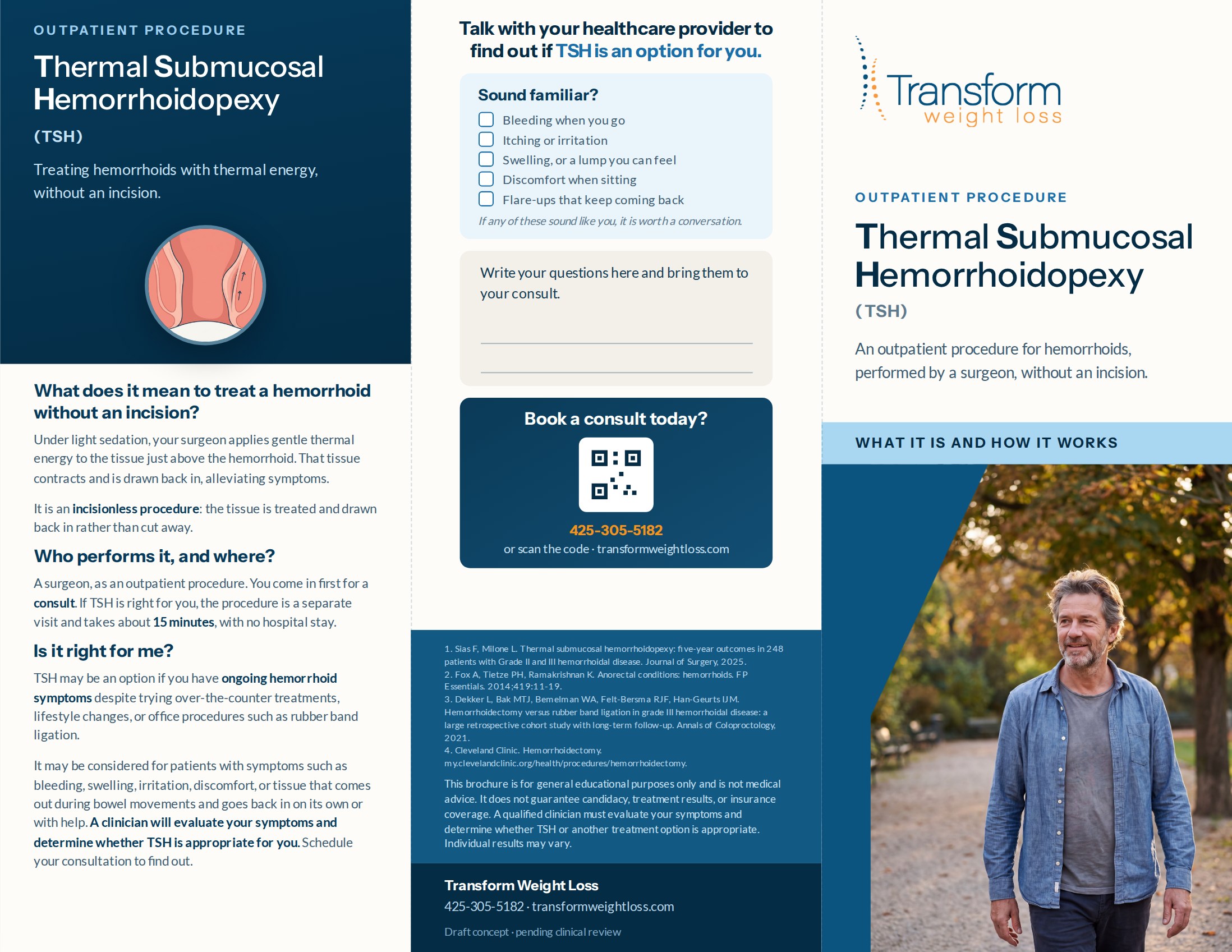
A double-sided piece to leave at the front desk for patients to pick up. The current brochure is embedded below exactly as it prints: standard letter, 8.5 by 11 inches, landscape, folded in three.
Outside · the side you see first
Inside · when it opens up
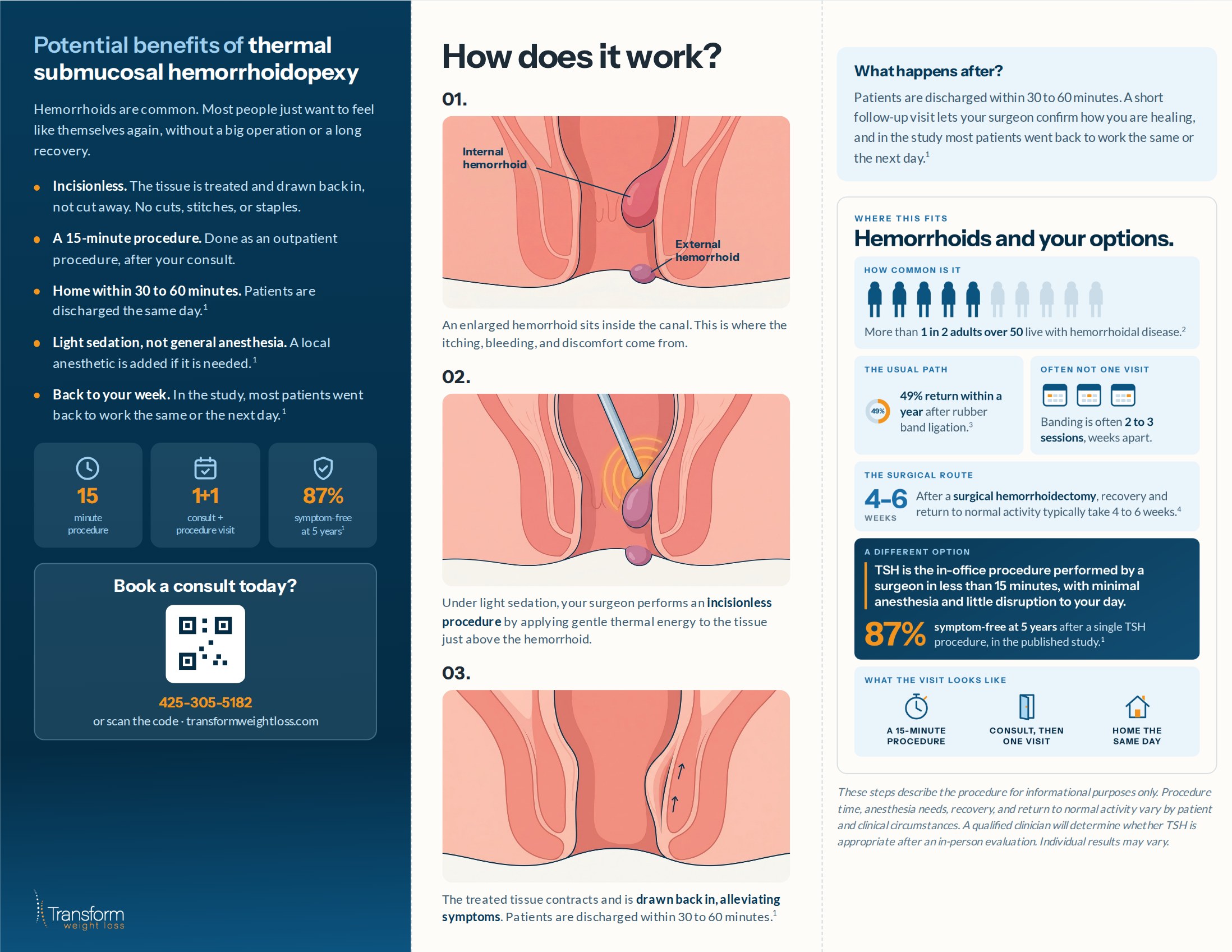
This is the current brochure, not a layout mock: copy, photography, the labelled step illustrations, and the options infographic are all in place, and the print PDF above is true 8.5 by 11 inches. The comparison figures now carry sources (see the source list on page 01). One figure still needs the clinic's word: the brochure says a surgical hemorrhoidectomy takes 4 to 6 weeks to recover from, while the Cleveland Clinic page cited for it gives an average of two to four weeks and a range of two to eight. Final production still goes to a designer, built to the exact size, bleed, fold, and colour profile of the print shop the clinic chooses.
For the nurses and NPs who bring it up first.
Patients rarely raise hemorrhoids on their own. It is usually a nurse or NP who hears the hint, a mention of itching, bleeding, or trouble sitting, and decides whether to open the topic. This card gives the team the words, so the conversation feels routine instead of awkward. It pairs with the education page (06) for the deeper background.
Talking about hemorrhoids, comfortably.
Most patients have carried this quietly for years. If the person raising it sounds unbothered and matter-of-fact, the patient usually follows their lead. That tone is the whole technique.
- "A lot of people deal with this and never mention it. If it has been bothering you, we can talk about it."
- "This is one of the most common things we see. Nothing you say will surprise anyone here."
- "You don't have to live around it. There are options now that don't mean a big operation, and the consult is just a conversation."
Then hand over the one-page handout, offer the brochure, and, if they are interested, offer to book the consult while they are still in the room.
page 06, Hemorrhoid education.
Internal reference for the clinical team, not a patient piece. All patient-facing language follows the approved wording on page 04, and clinical questions belong to the surgeon at the consult.
- 1 · Position
- Patient in the Sims position, left lateral decubitus.
- 2 · Sedation
- Light intravenous sedation with midazolam, supplemented as needed with propofol or a local anesthetic for anoscope insertion discomfort.
- 3 · Exposure
- The operative anoscope is inserted with the windows aligned to the left lateral, anterior, and right posterior hemorrhoidal nodules.
- 4 · Treatment
- Once the mucosa is identified, within 1 cm of the pectinate line, the electrode is inserted into the submucosa and a low-intensity current is delivered for 5 to 10 seconds, until visible whitening and volume reduction.
- 5 · Repeat
- Repeated above each hemorrhoid position, then the anoscope is rotated 180 degrees and the intermediate sites are treated the same way.
- 6 · Recovery
- Discharge within 30 to 60 minutes. All patients re-examined within 30 days.
- Anesthesia
- Every patient received light IV sedation with midazolam 2 mg. Propofol 30 to 40 mg was added in 35 patients, and local lidocaine (2%, 10 ml) in 72, for anoscope insertion discomfort. Not "local anesthesia for most patients"; the paper does not support that.
- Procedure time
- Average 10 minutes, range 5 to 15 minutes.
- Discharge
- All patients discharged within 30 to 60 minutes of surgery.
- Pain
- 92% reported no pain in the first five post-op days; 8% reported some, with a maximum VAS of 4 out of 10. Only 25 patients needed analgesics for more than two days.
- Return to work
- Most patients resumed work the same or the next day.
- Complications
- 38 (15.3%) minor bleeding, no intervention. 5 (2%) rehospitalised for bleeding requiring transfusion, days 1 to 8. 10 (4%) hemorrhoidal thrombosis. No urinary retention.
- Five-year outcome
- 216 of 248 (87%) completely asymptomatic. 32 (12.9%) minor residual prolapse or proctorrhagia, retreated locally.
- Pre-op guidance
- Eat whole foods, increase fiber, avoid white bread and processed food, avoid constipation and straining. Patients are asked to fast beforehand for anesthesia purposes. From Meribel's clinicians, not from the paper. The paper protocol overrides it.
A calm, dignified piece patients can pick up and trust.
Plain language, real evidence, no hype. The same voice as everything else in the kit.